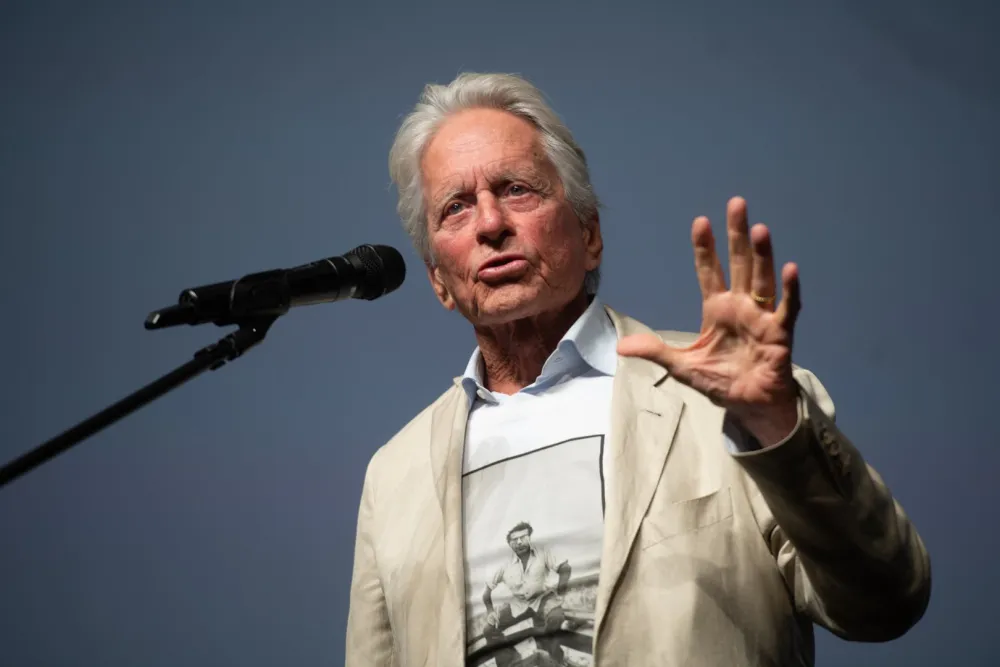
Hollywood veteran Michael Douglas recently shared some unexpected stories from his younger days, including an unusual way he helped pay for his college education. During an appearance on Real Time with Bill Maher, the Oscar-winning actor and producer discussed his extensive memoir, One Helluva Ride, reflecting on his remarkable career, his famous family background, and the experiences that shaped his journey through Hollywood.
The conversation took an entertaining turn when Douglas recalled transporting marijuana across the United States using luxury suitcases gifted to him by his father, legendary actor Kirk Douglas. The story offered a glimpse into a chapter of his life that predates his rise to Hollywood fame and came with a humorous observation about traveling before airport drug-detection dogs became a familiar presence.
Beyond the memorable anecdote, Douglas also addressed the ongoing debate surrounding so-called “nepo babies”—a term used to describe people who benefit professionally from having famous or influential parents. Drawing on his own experience as the son of one of Hollywood’s most recognizable stars, Douglas questioned why the entertainment industry receives so much criticism for family connections when similar arrangements exist in many other professions.
His appearance combined humor, personal history, and a defense of family influence in the workplace, while highlighting the complicated relationship between privilege, opportunity, and individual achievement.
Michael Douglas Discusses His Memoir, One Helluva Ride
Douglas appeared on Real Time with Bill Maher on Friday night to promote One Helluva Ride, a memoir that chronicles his life and career, from his early experiences to his achievements as an actor and producer.
Over the decades, Douglas has established himself as one of Hollywood’s most recognizable performers. His career has included acclaimed dramatic performances, major box-office productions, and important work behind the camera.
Among his most significant achievements was producing One Flew Over the Cuckoo’s Nest, the celebrated film that won the Academy Award for Best Picture. Douglas later received the Academy Award for Best Actor for his performance as Gordon Gekko in Wall Street, further strengthening his reputation as a major figure in the film industry.
His memoir explores the many experiences that contributed to his professional and personal development. As the conversation with Maher demonstrated, those experiences extend beyond award ceremonies, film sets, and Hollywood success.
Douglas also discussed the more unconventional aspects of his past, including stories involving drugs, money, and his attempts to manage the financial realities of being a college student.
The memoir’s wide-ranging subject matter provided an opportunity for the actor to look back on his life with humor and candor. Rather than focusing exclusively on his celebrated career, Douglas shared stories that revealed a younger version of himself—someone still figuring out how to support himself and establish independence.
The Surprising Marijuana Story From His College Years
One of the most memorable moments of the interview came when Douglas described how he helped cover his college expenses.
According to the actor, his father, Kirk Douglas, gave him a $10,000 check when he turned 21 and told him he was on his own. Although the gesture represented a significant amount of money, Douglas explained that he still had several years of tuition remaining.
That financial reality forced him to consider other ways to support himself.
During the conversation, Douglas recalled telling his father about two beautiful Italian soft-leather suitcases that Kirk had given him as a Christmas present. The younger Douglas had discovered that the suitcases could hold approximately 22 kilograms of marijuana each.
He explained that he would travel back east to visit his mother, carrying little more than the clothes he was wearing and the two suitcases.
The anecdote offered a surprising contrast to the polished image associated with a Hollywood star who would eventually win major acting awards and become a successful film producer.
Douglas described the period with humor, referring to the time as “BD,” or “Before Dogs,” a joke about the absence of the drug-detection dogs that are familiar in many modern security environments.
His story also reflected the circumstances of a different era. The anecdote concerned his college years, long before the security procedures and public conversations about drug enforcement that characterize contemporary travel.
Although Douglas presented the memory humorously, the account described the transportation of an illegal drug. His remarks were part of a retrospective conversation about his past rather than an endorsement of drug smuggling.
The story quickly became a standout moment because it revealed an unexpected side of an actor whose public image is closely associated with sophisticated performances, high-profile productions, and decades of professional success.
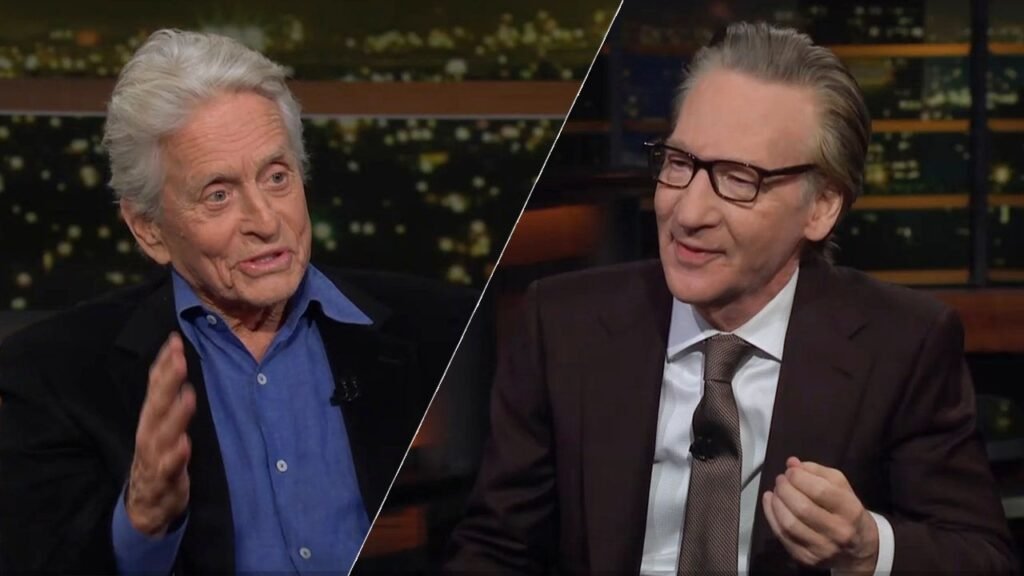
Bill Maher and Michael Douglas Find Common Ground
The discussion became even more entertaining when Maher suggested that he and Douglas shared an experience related to financing their college years.
Maher joked about the financial difference that could exist between purchasing marijuana in one location and selling it somewhere else. Douglas agreed, emphasizing that the difference could be particularly notable between the East Coast and West Coast.
Their exchange was delivered in a conversational, humorous style, allowing the actor to revisit an unconventional chapter of his life without turning the interview into a formal discussion about his career achievements.
The conversation also illustrated how memoir interviews can reveal stories that are not usually part of a celebrity’s public biography.
Douglas has spent much of his life in an industry where personal narratives often become intertwined with public image. Yet the college story presented a more informal portrait of his younger years, when he was dealing with the practical challenges of paying tuition and becoming financially independent.
The anecdote also highlighted the difference between the opportunities available to someone from a prominent entertainment family and the financial pressures that can still arise, even in households with considerable resources.
While Douglas benefited from having a famous father, his recollection suggested that his early adulthood was not entirely free of economic concerns. His account of working out how to pay for his education became one of the interview’s most unexpected revelations.
From Hollywood Family Connections to Working at a Gas Station
Another important part of the conversation focused on Douglas’s experience working ordinary jobs despite his father’s considerable success in the entertainment business.
Maher praised Douglas for taking on regular employment rather than relying exclusively on his family’s Hollywood connections.
One example involved Douglas working at a Mobil gas station in Connecticut when he was 20 years old. During that period, he reportedly earned recognition as “Mobil Man of the Month.”
The detail added another dimension to the discussion about privilege and opportunity.
Kirk Douglas was already an established Hollywood star, and growing up in such a household inevitably gave Michael Douglas a connection to the entertainment industry that many aspiring actors do not have.
However, Douglas’s recollection of working at a gas station offered a different perspective on his early adulthood. It showed that his experiences included employment outside the film business, even as he grew up surrounded by Hollywood’s culture and professional networks.
The conversation did not erase the advantages that can come with having a famous parent. Instead, it raised a broader question about how family background, personal effort, and professional opportunity interact.
For Douglas, the issue became particularly relevant when Maher’s praise for his early jobs led to a discussion about the increasingly common criticism directed at celebrity children.
Michael Douglas Challenges the ‘Nepo Baby’ Debate
The term “nepo baby” has become a familiar part of conversations about entertainment, referring to actors, musicians, directors, and other public figures whose family connections may help them enter competitive industries.
The debate often centers on whether children of established celebrities receive opportunities that are unavailable to equally talented people without influential parents.
Douglas addressed the subject directly during his interview, questioning why show business receives particular scrutiny for family-based professional opportunities.
“With this ‘nepo baby’ thing, doesn’t every single business, doesn’t a father or a mother want their son or daughter to go into the business?” he asked.
He also pointed to the existence of family-run companies, using businesses with names such as “so and so and sons” to illustrate his argument.
His central point was straightforward: family influence is not exclusive to Hollywood. In many industries, parents introduce their children to professional networks, help them learn a trade, or encourage them to continue a family business.
From Douglas’s perspective, the entertainment industry should not automatically be treated differently simply because the family connections are more visible.
His comments brought attention to a debate that has grown alongside social media, where celebrity backgrounds and professional opportunities are frequently examined in public.
Why the ‘Nepo Baby’ Conversation Remains Controversial
Although family businesses exist in many professions, the entertainment industry’s version of the debate has some distinctive characteristics.
Acting careers can depend on auditions, representation, access to casting directors, industry relationships, and the ability to secure early opportunities. Having a parent who is already established in Hollywood may make some of those steps easier.
Children of famous actors may grow up with access to industry knowledge, professional contacts, and environments that are unfamiliar to people entering the business without those advantages.
Critics of celebrity family connections argue that these benefits can make an already competitive industry even harder to enter for outsiders.
Supporters of family involvement, on the other hand, point out that being related to a successful actor does not automatically guarantee a lasting career. Performers still have to develop their skills, deliver convincing performances, and maintain professional relationships.
Douglas’s comments reflected this second perspective. He questioned why a parent encouraging a child to enter the same profession should be treated as inherently problematic when comparable situations are accepted elsewhere.
At the same time, his family background makes the subject particularly relevant to his own career.
Michael Douglas is the son of Kirk Douglas, whose achievements made him one of the defining stars of classic Hollywood. Growing up in that environment gave Michael a direct connection to the film industry, even before he established his own reputation.
His career subsequently included major performances and production achievements of his own. His Best Picture Oscar for producing One Flew Over the Cuckoo’s Nest and his Best Actor Oscar for Wall Street are important milestones in that career.
The discussion therefore raises a larger question: how should audiences distinguish between the advantages a person receives through family connections and the accomplishments they achieve independently?
There is no simple answer. Family support can create opportunities, but it does not fully explain the work, decisions, performances, or professional longevity that follow.
Douglas’s remarks invite audiences to consider the issue beyond a single label and to examine the relationship between inherited opportunity and individual achievement.
A Career That Extends Beyond His Famous Last Name
Michael Douglas’s professional identity has developed over several decades, spanning acting, producing, and participation in projects that have left a lasting mark on American cinema.
His achievements as a producer and performer demonstrate that his career cannot be reduced to his family background alone. One Flew Over the Cuckoo’s Nest became a landmark film, while Wall Street established one of his most recognizable screen performances.
Those accomplishments are significant parts of his legacy, independent of the public discussion surrounding celebrity families.
His memoir, One Helluva Ride, provides a framework for revisiting the experiences that shaped his journey, including the unusual stories from his younger years and the professional milestones that followed.
The appearance on Real Time with Bill Maher demonstrated how those different elements can come together in a single conversation. A discussion about a memoir became an opportunity to revisit college finances, unconventional decisions, early employment, family influence, and the challenges of building a career in a highly competitive industry.
It also showed how a celebrity interview can move between humor and a more serious discussion about social expectations.
Douglas’s marijuana-smuggling anecdote attracted attention because it was so different from the polished image often associated with an award-winning Hollywood actor. His response to the “nepo baby” debate, meanwhile, offered a glimpse into how he views the relationship between family background and professional success.
What Michael Douglas’s Interview Reveals About His Life
The conversation with Maher highlighted two major themes in Douglas’s story: the importance of family connections and the role of personal experience in shaping a career.
His father’s name and success undoubtedly placed him close to the entertainment business. At the same time, Douglas described a younger life that included tuition expenses, ordinary employment, and decisions that were far removed from the glamour of Hollywood.
The two sides of his story help explain why the “nepo baby” discussion remains so complicated. Family connections can provide a meaningful advantage, but the public debate often becomes oversimplified when it treats those connections as the sole explanation for a person’s career.
Douglas pushed back against that simplification by comparing entertainment with family-run businesses in other industries. Whether audiences agree with his position or not, his comments reflect a longstanding question about how opportunity is passed from one generation to the next.
His appearance also served as a reminder that a celebrity memoir can contain more than a record of professional achievements. It can offer personal anecdotes, unexpected admissions, and reflections on the decisions that helped shape a person’s life.
For readers interested in Hollywood history, Douglas’s stories provide a window into the experiences that preceded his rise to prominence. For those following the ongoing debate about celebrity privilege, his comments add another perspective to a discussion that shows little sign of disappearing.
Ultimately, the interview brought together an unusual story from Douglas’s college years and a contemporary debate about professional opportunity. It offered humor, nostalgia, and a defense of family influence while leaving audiences to consider a larger question: how much of success comes from where someone begins, and how much comes from what they do with the opportunities they receive?