
The timeless story of the Ramayana is preparing to reach cinema audiences in a spectacular new form. Sony Pictures has unveiled the trailer for Ramayana: Rise of a Legend, an ambitious Indian film starring Ranbir Kapoor as Prince Rama and Yash as the formidable warrior king Ravana. The movie aims to bring one of India’s most influential epics to the big screen through large-scale visual effects, powerful performances, and a musical score created by two internationally recognised composers.
The trailer offers audiences an early look at the film’s interpretation of the legendary conflict between Rama and Ravana. Rooted in the ancient Sanskrit epic traditionally attributed to the sage Valmiki, the story has inspired generations through its themes of duty, courage, loyalty, sacrifice, righteousness, and the struggle between good and evil.
With Kapoor taking on the role of Rama and Yash portraying Ravana, the film brings together two major Indian stars for a story with enormous cultural significance. The supporting cast includes Sai Pallavi, Sunny Deol, and Ravi Dubey, adding further interest to the production.
The film is also drawing attention for its technical ambitions. Its visual effects involve artists who have worked on internationally recognised productions such as Dune, The Odyssey, and Interstellar. The music brings together Hans Zimmer and A. R. Rahman, two composers whose work has reached audiences across different countries and cinematic traditions.
Ramayana: Rise of a Legend is scheduled to arrive in theatres and IMAX on November 5. As anticipation builds, the newly released trailer gives audiences their first opportunity to see how this adaptation plans to translate an ancient epic into a modern cinematic experience.
Ramayana: Rise of a Legend Trailer Introduces a New Cinematic Vision
The newly released trailer offers a glimpse into the world of Ramayana: Rise of a Legend, introducing the central characters and the epic conflict at the heart of the story.
Rather than presenting the film as a contemporary drama, the production draws on the mythology and scale of the traditional narrative. Its central figure is Prince Rama, the heir to the kingdom of Ayodhya, whose journey places him in conflict with Ravana, a powerful warrior king.
The trailer is designed to introduce audiences to this world without revealing every detail of the film’s narrative. For viewers already familiar with the Ramayana, the characters and central conflict will be recognisable. For international audiences or younger viewers encountering the story for the first time, the film may offer an accessible introduction to one of India’s most enduring literary traditions.
The cinematic challenge is considerable. The Ramayana encompasses royal families, divine intervention, extraordinary journeys, complex moral decisions, and battles involving powerful forces. Adapting such a story requires more than recreating familiar episodes; filmmakers must also decide how to shape the narrative for a modern audience while respecting its cultural and spiritual significance.
The trailer has already placed the film in the spotlight because of its cast, visual ambitions, and musical collaborators. However, the complete scope of its production and the way it interprets individual episodes will become clearer as more footage and information are released.
For now, the first trailer establishes the scale of the project and introduces the actors bringing its central figures to life.

Ranbir Kapoor Plays Prince Rama
Ranbir Kapoor takes on the role of Prince Rama, one of the most important figures in Indian religious and literary tradition.
In the Ramayana, Rama is associated with righteousness, responsibility, self-discipline, and commitment to duty. His journey is not simply a battle against a powerful opponent; it is also a story about making difficult decisions while attempting to uphold moral principles.
Rama’s position as the heir to Ayodhya places him within a world of royal responsibilities and family relationships. His journey eventually becomes much larger than the concerns of a single kingdom, developing into an epic involving loyalty, separation, perseverance, and the restoration of order.
Portraying such a widely recognised character presents a distinctive challenge for any actor. Audiences may already have strong ideas about Rama’s personality, appearance, and moral qualities because the story has been retold through religious texts, television serials, theatre, dance, paintings, and regional adaptations.
Kapoor’s performance will therefore be closely watched by viewers interested in how the film interprets the character.
The production also has the opportunity to introduce Rama to audiences who may be less familiar with the original epic. A strong adaptation can help viewers understand not only the character’s heroic qualities but also the obligations and personal sacrifices that shape his journey.
However, the trailer provides only an initial glimpse of Kapoor’s portrayal. A fuller assessment of his performance will depend on the completed film and how the character develops across the story.
For Kapoor, the role represents an opportunity to participate in a major mythological production built around a narrative with centuries of cultural influence.
Yash Takes on the Role of Ravana
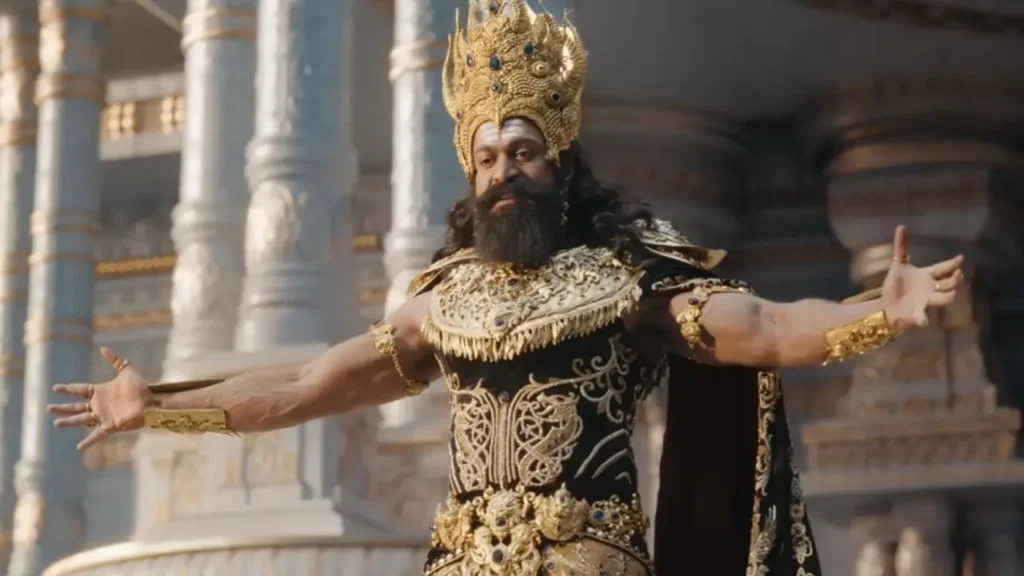
Yash plays Ravana, the warrior king who stands at the centre of the epic’s principal conflict.
Ravana is one of the most complex and recognisable antagonists in Indian mythology. He is often portrayed as a formidable ruler whose power, knowledge, ambition, and pride contribute to his place in the story.
His conflict with Rama drives the narrative towards a confrontation that has been interpreted in many different ways across India’s literary and cultural traditions.
Bringing Ravana to the screen presents an important creative decision. The character must be powerful enough to represent a serious challenge to Rama, while the film’s interpretation will determine how his motivations and personality are presented to audiences.
Yash’s casting has attracted attention because the actor is known for commanding screen presence and performances in large-scale commercial cinema. The role gives him an opportunity to portray a character whose reputation extends far beyond an ordinary cinematic villain.
The film’s portrayal of Ravana may also influence how viewers experience the central conflict. A compelling antagonist can give a mythological story dramatic weight, particularly when the confrontation involves questions of power, responsibility, pride, and the consequences of personal choices.
At the same time, the character’s portrayal carries cultural significance. Ravana has been represented differently in various regional traditions, and audiences may bring different interpretations to the cinema.
The filmmakers’ approach will ultimately determine how the character is presented in this particular adaptation.
With Kapoor as Rama and Yash as Ravana, the film places two prominent performers at the centre of a story whose conflict has remained familiar to generations.
Understanding the Ramayana and Its Cultural Significance
The Ramayana is one of the foundational epics of Indian culture. Traditionally attributed to the sage Valmiki, the Sanskrit work tells the story of Rama and his journey through duty, exile, conflict, and the struggle to rescue his wife, Sita, from Ravana.
The narrative has influenced religious practices, literature, performing arts, festivals, storytelling, and popular entertainment throughout South Asia and beyond.
Although the Sanskrit epic is among the best-known versions, the Ramayana has been retold in numerous languages and cultural settings. These adaptations sometimes differ in their characterisation, emphasis, and interpretation of particular events.
The story’s continuing relevance comes partly from its exploration of moral and social responsibilities. Rama’s journey is associated with the obligations of leadership and family, while the wider narrative examines loyalty, courage, perseverance, and the consequences of choices.
Ravana’s role provides a central opposing force, creating a conflict that has traditionally been understood through the relationship between righteousness and the misuse of power.
However, the epic is also richer than a simple contest between a hero and a villain. Its many retellings have generated discussions about duty, justice, relationships, authority, and the challenges of making ethical decisions.
A large-scale film adaptation has the opportunity to bring these themes to new audiences through visual storytelling, performances, music, and cinematic spectacle.
At the same time, filmmakers adapting culturally significant material face the responsibility of treating the source with care. Audiences may approach the film from religious, historical, literary, or purely cinematic perspectives, and their expectations may differ.
The success of Ramayana: Rise of a Legend will depend not only on the scale of its production but also on how effectively it communicates the emotional and moral foundations of the story.
Sai Pallavi, Sunny Deol and Ravi Dubey Join the Cast
Alongside Kapoor and Yash, the film features Sai Pallavi, Sunny Deol, and Ravi Dubey.
The supporting cast is an important part of a story as expansive as the Ramayana. The epic contains numerous characters whose relationships, decisions, and allegiances help shape the central journey.
Sai Pallavi’s involvement adds further interest to the production. The character she plays is an important point of audience interest, although the supplied announcement does not provide a complete breakdown of every role.
Sunny Deol is another notable addition to the cast. His established screen presence could bring considerable weight to the film, depending on the nature and scale of his character.
Ravi Dubey also joins the ensemble, expanding the group of performers involved in bringing the epic’s world to the screen.
The production has not disclosed every detail of the supporting characters in the information provided here. It would therefore be premature to assign specific roles without an official confirmation.
As further promotional material becomes available, audiences may learn more about how the supporting cast fits into the story and which episodes from the traditional narrative receive the greatest attention.
A mythological epic often depends on the relationships between its central figures and the wider world around them. The supporting characters can establish the emotional stakes, explain the conflicts, and give the main story a broader sense of scale.
For that reason, the performances beyond the two central roles will also be important to the film’s overall impact.
Hollywood-Level Visual Effects Aim to Bring the Epic to Life
One of the most talked-about aspects of Ramayana: Rise of a Legend is its visual-effects work.
The production is reported to involve visual-effects artists who have worked on films including Dune, The Odyssey, and Interstellar. Those projects are associated with ambitious cinematic environments and technically demanding visual storytelling.
For a film based on the Ramayana, visual effects can play a major role in establishing the world in which the story unfolds.
The narrative includes royal cities, forests, extraordinary journeys, supernatural elements, and large-scale battles. Bringing these settings to the screen requires careful coordination between production design, cinematography, visual effects, costumes, and action choreography.
Computer-generated imagery can help create locations and events that would be difficult or impossible to film practically. However, effective visual storytelling requires more than impressive images. The effects must serve the characters and narrative rather than distracting audiences from the emotional core of the story.
The challenge is particularly significant when adapting a narrative that many viewers already imagine through traditional art and cultural representations.
Filmmakers must decide how to translate those familiar images into a cinematic language that feels convincing while creating its own identity.
The involvement of experienced visual-effects artists may help the production realise its ambitions, but the final results will only be fully assessable when audiences see the finished film.
The trailer offers an early indication of the project’s visual direction, while the theatrical and IMAX presentation is intended to give audiences an opportunity to experience the film on a large screen.
For viewers interested in spectacle, the production’s technical approach will be one of the major aspects to watch.

Hans Zimmer and A. R. Rahman Create the Film’s Musical Identity
The music for Ramayana: Rise of a Legend brings together Hans Zimmer and A. R. Rahman, two composers with international reputations.
Zimmer is known for scores that combine orchestral writing, electronic textures, and powerful musical themes. His work has helped shape the sound of numerous major films, including large-scale science-fiction and action productions.
Rahman, meanwhile, is recognised for blending Indian musical traditions with contemporary orchestration and global influences. His work has reached audiences through Indian cinema and international projects.
Bringing the two composers together creates the possibility of a score that combines different musical approaches while supporting the film’s cultural setting.
Music can be particularly important in mythological storytelling. It can establish the atmosphere of a royal court, heighten the tension of a confrontation, give emotional weight to a character’s sacrifice, or build anticipation before a major battle.
A memorable score may also help distinguish a new adaptation from earlier versions of the same story.
The collaboration between Zimmer and Rahman is therefore one of the production’s most intriguing creative elements.
However, the final musical approach will depend on how the score is used throughout the film. The trailer provides only a limited introduction to the soundtrack, and the complete compositions have not been discussed in detail in the supplied announcement.
Audiences will learn more about the musical identity of the film as further promotional material becomes available.

Ramayana: Rise of a Legend Release Date and IMAX Plans
Ramayana: Rise of a Legend is scheduled to open in theatres and IMAX on November 5, according to the supplied announcement.
The IMAX release is notable because the film’s large-scale settings, visual effects, and action sequences are suited to an expansive theatrical presentation.
For viewers, watching an epic on a large screen can create a more immersive experience than viewing it on a television or mobile device. The scale of the environment, the movement of the action, and the impact of the soundtrack can all contribute to the experience.
However, the quality of that experience will depend on the finished film and how its images and sound have been prepared for theatrical exhibition.
The supplied announcement does not specify the year alongside the November 5 date. Before publishing, the release year should be confirmed against the studio’s official announcement so that readers receive accurate information.
The film’s release strategy may also become clearer as its marketing campaign develops. Additional trailers, posters, interviews, and behind-the-scenes material could reveal more about its production and intended audience.
Until those updates arrive, November 5 remains the reported release date, with the year requiring confirmation from an official source.
Why Ramayana: Rise of a Legend Could Become a Major Cinematic Event
The combination of a familiar epic, a high-profile cast, experienced visual-effects artists, and internationally recognised composers gives Ramayana: Rise of a Legend several elements that could attract attention beyond its core audience.
For Indian viewers, the story carries cultural and literary significance. Many will already know its major characters and events, but they may be interested in seeing how a contemporary production interprets them through modern filmmaking techniques.
For international audiences, the film could provide an introduction to a foundational story that has influenced art and storytelling for generations.
The cast also offers a point of connection for viewers who follow Indian cinema, while the involvement of Zimmer and Rahman may draw interest from music fans.
Nevertheless, a large production and recognisable names do not automatically guarantee critical or commercial success. The finished film will need to deliver a compelling story, convincing performances, effective visual effects, and a score that supports the narrative.
Respectful treatment of the source material will also matter, particularly because the Ramayana has religious and cultural importance for many people.
The trailer is an early step in establishing the film’s identity. The next stages of promotion may provide a clearer sense of its tone, narrative priorities, and approach to the characters.
For now, the project has created considerable curiosity by bringing together a well-known epic and a contemporary cinematic team.
Final Thoughts
The trailer for Ramayana: Rise of a Legend introduces a major new adaptation of one of India’s most enduring epics.
Ranbir Kapoor leads the film as Prince Rama, while Yash plays Ravana. Sai Pallavi, Sunny Deol, and Ravi Dubey are also part of the cast. The production’s reported visual-effects talent and the musical collaboration between Hans Zimmer and A. R. Rahman add to its ambitions.
The story draws on the Ramayana, traditionally attributed to Valmiki, and its enduring themes of duty, courage, loyalty, sacrifice, and the consequences of power.
The film is scheduled for a theatrical and IMAX release on November 5, although the release year should be verified before publication.
Ultimately, the film’s success will depend on how well it balances cinematic spectacle with the emotional, moral, and cultural dimensions of the original epic.
For now, the trailer offers the first glimpse of a production aiming to bring a timeless story to a new generation of moviegoers.