
When a story’s imagined future finally collides with the real calendar, something interesting always happens. Stephen King’s 1982 novel The Running Man envisioned a totalitarian America in the year 2025 — a society divided between elites and the poor, monitored by surveillance technology and manipulated by fake media. Fast-forward to the actual 2025, and filmmaker Edgar Wright has reimagined King’s dystopia for a new generation. The irony? The world King predicted has, in many ways, already arrived — making this version of The Running Man both timely and strangely outdated.
A Familiar Story Reimagined
The story follows Ben Richards (played by Glen Powell), an unemployed worker struggling to survive in a divided America. Once a loyal laborer, Richards loses his job after questioning unsafe working conditions and showing signs of rebellion. With a sick baby at home and his wife (Jayme Lawson) considering dangerous work to keep them afloat, desperation drives him toward the most extreme job opportunity imaginable — a deadly reality show called The Running Man.
In this televised nightmare, contestants must survive for 30 days while being hunted by armed pursuers. The catch? Every citizen who spots them can turn them in for cash. It’s a brutal game where entertainment and exploitation blur, and the “contestants” are treated like disposable entertainment for a society addicted to violence and spectacle.
The Evolution of a Classic
Fans will remember the 1987 adaptation starring Arnold Schwarzenegger, a cult favorite known for its over-the-top violence and sharp satire. That film, set in 2017, was more of an action-driven spectacle — a neon-soaked commentary on reality TV, media manipulation, and state control.
Wright’s version attempts something different: a sleeker, more modern look at surveillance capitalism, digital propaganda, and AI deepfakes. But while the premise remains potent, the film’s execution struggles to keep up with its own ideas.
Powell brings charm and charisma to the role, but the film never fully commits to either a biting satire or a serious thriller. Instead, it hovers somewhere in between — visually stylish but emotionally distant.
A Cast of Strong Performers
The film’s ensemble is impressive. Josh Brolin delivers a standout performance as Dan Killian, the manipulative head of the Network — the powerful media conglomerate that runs the deadly game. With his polished demeanor and cold smile, Brolin embodies the face of corruption and control. His Killian is the kind of villain who smiles while selling moral decay, and his scenes are some of the film’s sharpest.
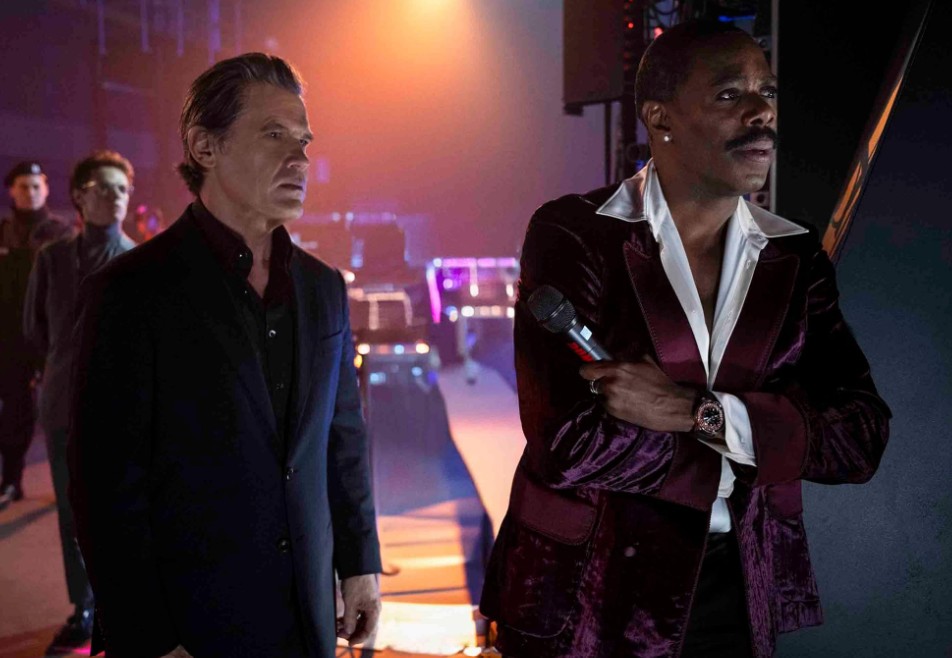
Meanwhile, Colman Domingo shines as Bobby Thompson, the flamboyant host of the televised bloodsport. Domingo channels the energy of a modern-day showman with unnerving ease, his grin masking the sinister machinery behind the entertainment.
Michael Cera, in a surprise turn, plays an eccentric rebel who helps Richards during the chase — essentially a grown-up Kevin McCallister type, crafting elaborate traps and pranks to outwit pursuers. It’s a bizarre but oddly fun addition that gives the movie brief comedic relief.
From the Streets to the Screens
Once Richards joins the game, The Running Man transforms into a chase thriller spanning from New York to Maine. The contestants, including Katy O’Brian and Martin Herlihy, are dropped into real-world environments with only a small head start before the “hunters” — led by a masked Lee Pace — begin pursuit.
Drones capture every second for live broadcast, turning human survival into high-definition entertainment. The visual design of these sequences is sleek and fast-paced, filled with Wright’s signature energy and kinetic editing. However, beneath the surface spectacle, there’s a sense of déjà vu — the film echoes The Hunger Games, Black Mirror, and even the original The Running Man, without adding much new insight.
The Challenge of Updating a Dystopia
Edgar Wright, known for genre-blending films like Shaun of the Dead and Baby Driver, brings his usual flair for movement and rhythm. But here, that kinetic style collides awkwardly with the story’s grim undertones. The original book’s darkness — rooted in poverty, desperation, and government control — is largely softened in favor of satire.
The result is a movie that looks great but lacks emotional punch. Wright co-wrote the screenplay with Michael Bacall, infusing it with humor and visual wit, but the tension between comedy and commentary often blurs the message.
What’s missing is the raw sense of rebellion that made King’s story so haunting. The narrative of The Running Man was always about class struggle and exploitation — ordinary people turned into entertainment for the privileged. In Wright’s glossy version, the satire feels too safe, too polished to sting.
A Timely Message About Media Manipulation
Yet, even with its flaws, The Running Man manages one eerily relevant theme: the manipulation of truth in the digital age. As Richards’ popularity grows, the Network begins altering his image using advanced AI, making him appear violent or subversive on-screen.
This idea — that media can rewrite reality — hits uncomfortably close to home. Killian even admits he can make Richards say or do anything digitally, but still prefers real contestants because “humans get better ratings.”
It’s a chilling observation about today’s media culture, where authenticity is manufactured and outrage sells. In that sense, Wright’s film accidentally becomes a reflection of modern-day news cycles, social media manipulation, and the rise of artificial storytelling.
Performances That Keep It Running
Despite its uneven tone, the performances save the film from collapsing. Powell handles the action sequences with physical confidence, even if his character lacks emotional complexity. Domingo and Brolin elevate the film with their layered portrayals of media puppeteers, while Michael Cera provides comic unpredictability.
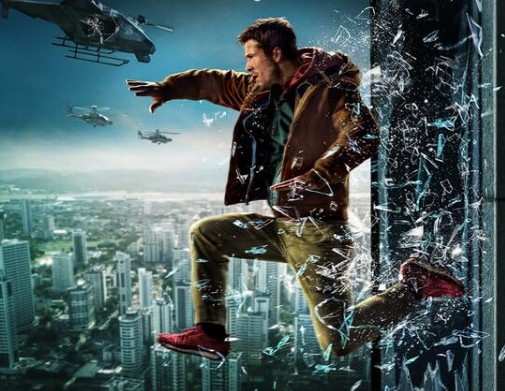
Wright’s direction ensures the film never drags, even when the script falters. The pacing is sharp, and the visuals — drenched in neon and steel — reflect a world that’s both futuristic and eerily familiar.
Final Verdict
The Running Man (2025) is stylish, entertaining, and occasionally thought-provoking, but it never reaches the biting edge of its source material. It’s a film caught between satire and sincerity — visually stunning yet emotionally hollow.
For Edgar Wright, it’s an ambitious but imperfect experiment in reinterpreting dystopia for a world that’s already living one. For audiences, it’s a reminder that even when fiction tries to outrun reality, sometimes, reality catches up first.