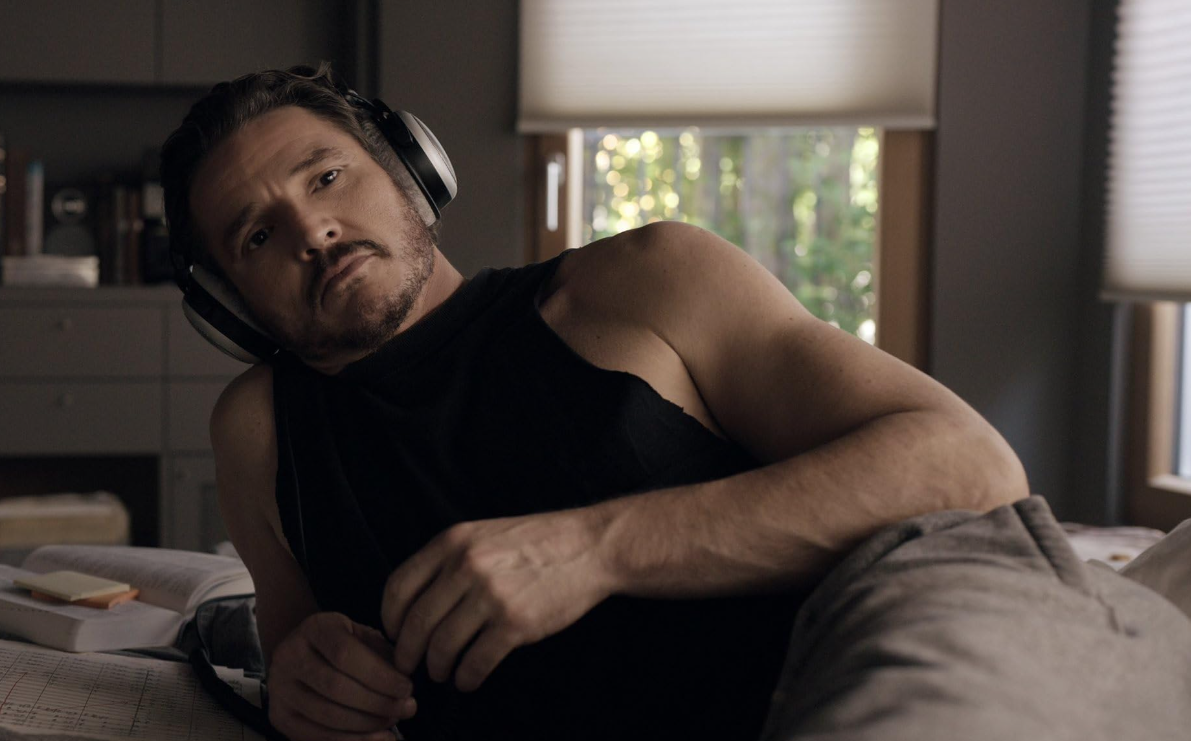
Pedro Pascal is used to taking on demanding roles, but his latest challenge required something he had never mastered before: the cello.
The actor, best known for performances in projects such as The Last of Us and The Mandalorian, had only three months to learn enough cello to convincingly portray an orchestra virtuoso in Behemoth!, the new drama written and directed by Tony Gilroy.
The film world-premiered at the New York Film Festival, where Pascal opened up about the intense preparation required to play Hollywood session cellist Alex.
For Pascal, learning the instrument became much more than a preparation exercise. The cello followed him everywhere during production, forcing him to spend countless hours learning techniques that musicians typically develop over years.
He described the experience as both “hell and heaven,” calling it the hardest creative challenge he has ever undertaken.
Pedro Pascal Had Just Three Months to Learn the Cello
When Tony Gilroy approached Pascal about Behemoth!, the actor knew immediately that the role came with a major technical challenge.
Alex is not simply a character who happens to play the cello.
He is an accomplished professional musician.
That meant Pascal couldn’t simply pretend to play the instrument on camera. He needed to develop enough skill and physical familiarity to make Alex’s performances believable.
Gilroy asked Pascal whether he could take on the challenge.
Pascal’s honest response was uncertainty.
“I was like, ‘I really don’t know,’” the actor recalled during a press conference at Lincoln Center’s Walter Reade Theatre.
Rather than turning down the opportunity, however, Pascal decided to commit himself fully.
“I understand the assignment and I’m gonna jump right the hell in, but I can’t tell you if I’m going to get an A,” he told Gilroy.
The actor ultimately had approximately three months to prepare.
For someone playing a professional cellist, that is an extremely short period.
Musicians spend years developing the physical coordination, muscle memory, timing and precision necessary to perform difficult pieces.
Pascal was effectively trying to compress years of training into weeks.
“The Cello Was the Main Character of My Life”
Pascal’s preparation quickly became an all-consuming experience.
He explained that the cello essentially became part of his everyday life.
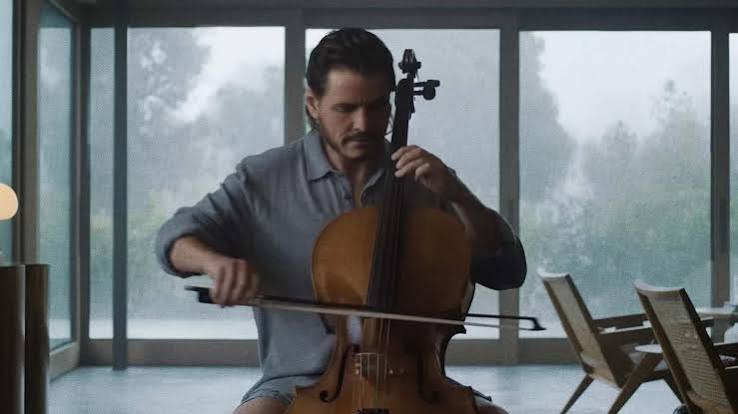
“The cello was the main character of my life. I took it everywhere with me,” Pascal said.
The actor described the experience as a mixture of extreme difficulty and genuine excitement.
“It was hell and heaven,” he said.
The description captures the unusual nature of the challenge.
On one hand, Pascal was attempting to learn a complicated musical instrument under enormous time pressure.
On the other, he was getting the opportunity to work closely with another artist and learn an entirely new physical discipline.
He described the process as “incredible” because it forced him to return to the experience of being a student.
The preparation wasn’t only about learning notes.
Pascal had to become familiar with the instrument itself.
He had to learn how to hold it.
He had to understand the bow.
He had to develop physical movements that would look natural on camera.
And he had to do all of this quickly enough for audiences to believe that Alex was a genuine professional musician.
Learning the Bow Was One of His Biggest Challenges
One of the most difficult parts of Pascal’s preparation involved something musicians normally learn very early: how to properly control the bow.
Pascal explained that a beginner might spend an entire year learning to hold and use the bow correctly.
He had approximately a week.
“You’re supposed to spend a year learning how to really hold the bow correctly and I had a week,” he said.
The actor admitted that he never completely caught up to the level expected of a professional cellist.
But rather than viewing that as a failure, Pascal found something valuable in the struggle.
“I never caught up to it, which was the ecstasy of it, I suppose.”
That comment reflects the unusual demands placed on actors when they portray highly specialized professionals.
They don’t necessarily need to become experts in the real-world sense, but they have to understand the discipline deeply enough to make the character convincing.
For Pascal, the process appears to have transformed the way he approached Alex.
The cello became part of the character rather than simply a prop.
The Physical Challenge Changed Pascal’s Creative Process
Actors frequently prepare for roles through research, rehearsals and conversations with experts.
For Behemoth!, Pascal’s preparation was much more physical.
He had to repeatedly perform movements associated with playing the cello.
He had to develop coordination between both hands.
He had to learn the posture and body language of a musician.
And he had to perform under the pressure of filming.
Pascal described the meticulous nature of the process as part of what made it so demanding.
At the same time, he appreciated being placed in a position where he had to learn something from scratch.
The actor called it the hardest thing he had ever done creatively.
That makes the cello more than a behind-the-scenes curiosity.
It appears to be central to how Pascal connected with Alex.
What Is Behemoth! About?
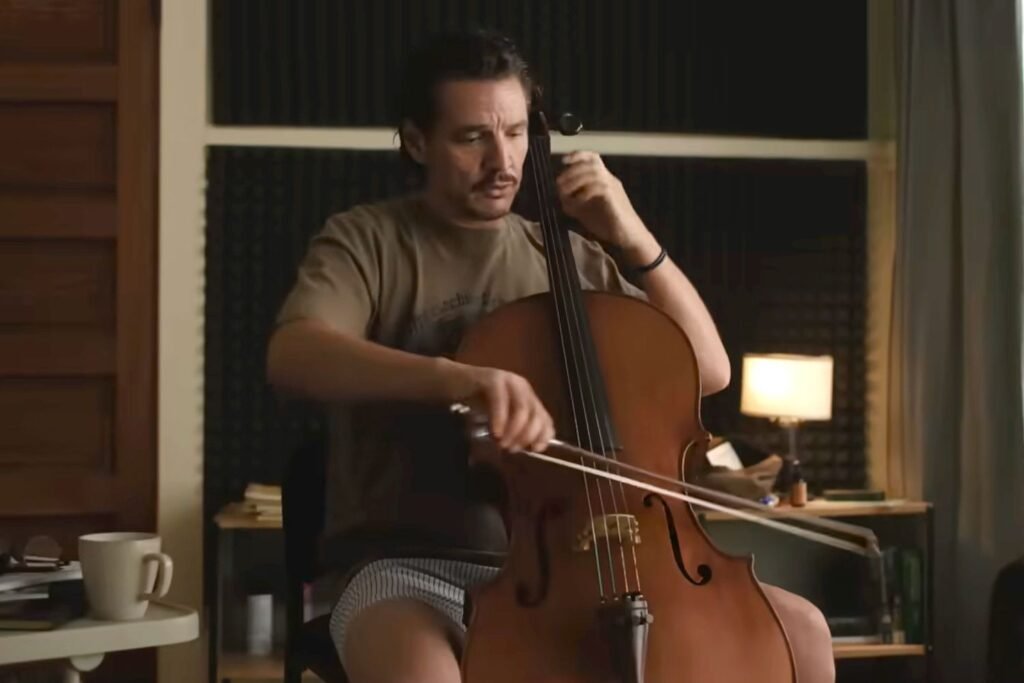
Written and directed by Tony Gilroy, Behemoth! follows Alex, a womanizing Hollywood session cellist whose personal and professional lives begin to collide.
Alex is an accomplished musician, but his career does not necessarily mean that his personal life is equally successful.
The story explores loss, romance, family and artistic ambition.
Alex is haunted by the presence of his ruthless father while also caring for his ailing mother.
His complicated family history adds emotional pressure to a character who is already struggling with relationships and his career.
The story changes when Alex begins taking an interest in a young musical prodigy.
That relationship becomes increasingly important and gives Alex an opportunity to confront aspects of himself and his life that he may have previously avoided.
The film therefore isn’t simply about music.
The cello provides the professional setting, but the emotional heart of the story appears to be Alex’s relationships and the choices he makes.
Olivia Wilde Brings Comedy to the Drama
Olivia Wilde plays Carol, Alex’s volatile former flame.
Her character follows him to Los Angeles, creating another complication in Alex’s already unstable personal life.
Wilde reportedly becomes one of the movie’s major scene-stealers, bringing humor and energy to a story that otherwise deals with serious themes involving family, loss and artistic identity.
Carol’s presence adds another dimension to Alex’s romantic history.
Their relationship suggests that Alex’s past isn’t willing to remain in the past.
That dynamic can also provide the film with moments of comedy amid its heavier emotional material.
Eva Victor Plays Nadia
Another important figure in Alex’s story is Nadia, played by Eva Victor.
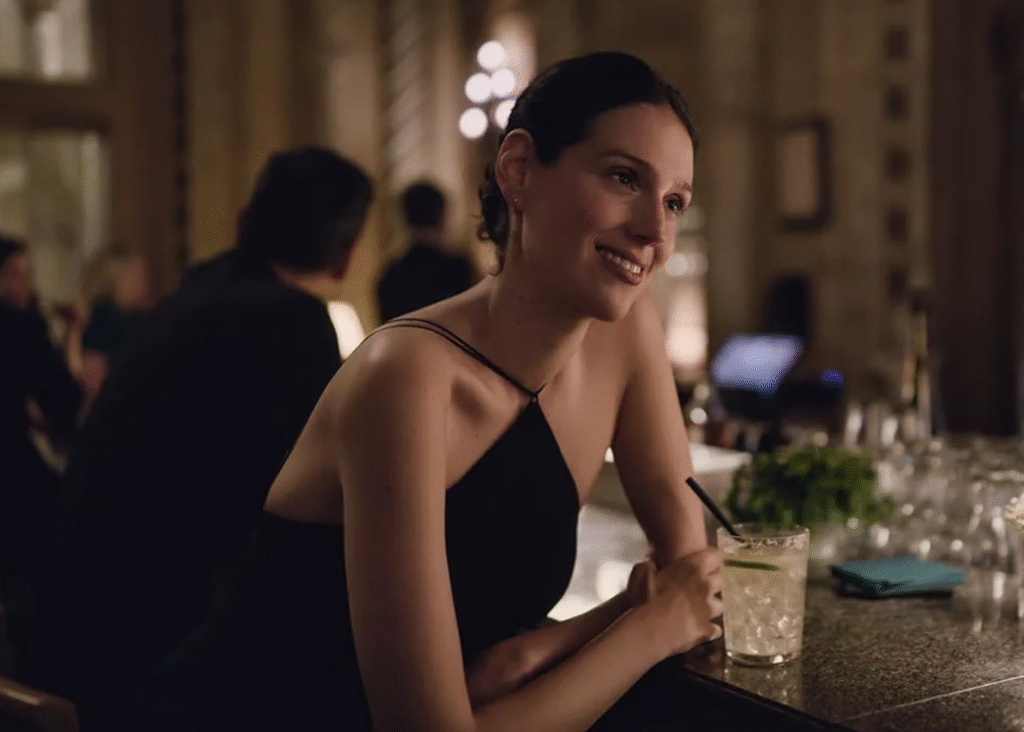
Victor gained attention for Sorry, Baby, and in Behemoth! she portrays a violinist who shares a brief but deeply meaningful relationship with Alex.
The relationship between Nadia and Alex appears to be one of the emotional centers of the film.
Although their time together may be limited, the connection leaves a lasting impact on both characters.
Victor also had to learn an instrument for the role.
Her character plays violin, and one of her earliest scenes required her to perform approximately 20 seconds of “Happy Birthday.”
That may sound simple.
It wasn’t.
Victor revealed that she spent two months practicing for three hours a day to prepare for those few seconds.
Her experience demonstrates just how seriously the production approached the musical performances.
Eva Victor’s Personal Connection to the Role
Victor’s preparation for Behemoth! also carried an unexpected personal significance.
She revealed that her grandfather had been a violin and cello teacher and had passed away a couple of months before she received the opportunity.
When she read the script and discovered that she would be taking violin lessons, she felt a powerful personal connection.
“I read the script and it was like, ‘We’re going to have you in two months of violin lessons.’ I was like, ‘OK, thanks Grandpa, I guess we’re learning violin finally.’”
The coincidence made the role feel especially meaningful.
What could have been simply another acting assignment became connected to her family’s history.
That emotional connection may have added another layer to her performance as Nadia.
Pascal and Victor Had to Build Their On-Screen Connection
Victor also admitted that she initially felt nervous about acting opposite Pascal.
The reason was understandable.
Her character develops an intimate relationship with Alex, meaning the two performers needed to establish trust quickly.
Victor recalled being told that she would have to share a romantic scene with Pascal.
Her reaction was humorous and honest.
“It was like: ‘You’re gonna make out with him,’ and I was like, ‘Oh my God, really?’”
However, she said Pascal made the experience comfortable.
“He was so warm to me,” Victor explained.
The two actors discussed the importance of Alex and Nadia’s relationship and why their connection ultimately becomes so tragic.
Their conversations helped establish the emotional foundation for the characters.
That preparation was particularly important because the relationship isn’t simply a romantic subplot.
It appears to represent something Alex desperately needs but may ultimately be unable to hold onto.
An Extraordinary Musical Team Created the Score
The musical dimension of Behemoth! extends beyond the performances by Pascal and Victor.
The movie features a major score created by an impressive group of composers, including James Newton Howard, Alan Silvestri and Michael Giacchino.
Their involvement adds another significant musical component to a film already centered on professional musicians.
Each composer brings an extensive history of film scoring, making the score an important part of the movie’s atmosphere.
For a story about a cellist and a violinist, music isn’t simply background material.
It is part of the world the characters inhabit.
The score can therefore function alongside the cello and violin performances to reinforce the emotional journey.
Pedro Pascal’s Favorite Film Scores
During the festival Q&A, Pascal was also asked about film music and revealed some of his favorite scores.
Among his choices were The Color Purple and Empire of the Sun.
Both films are known for their powerful musical identities, demonstrating Pascal’s appreciation for the way a score can shape the emotional experience of a movie.
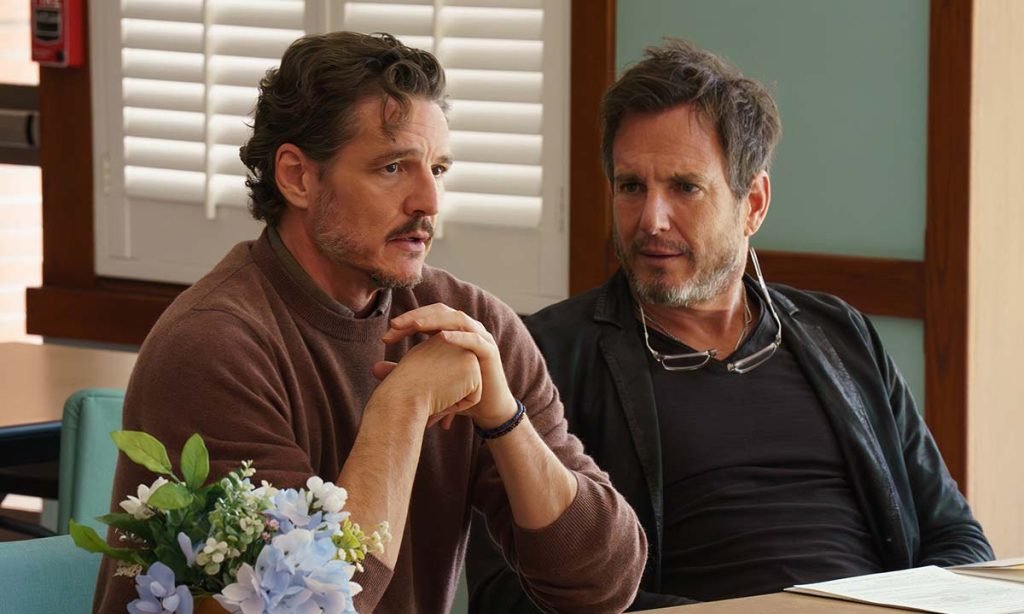
His co-star Will Arnett, who plays Alex’s podcaster brother Andy, offered a more unexpected answer.
Arnett mentioned The Last Temptation of Christ as a favorite.
He then admitted that although he has listened to the score thousands of times, he has never actually seen the movie.
The admission reportedly produced laughter during the festival discussion.
Tony Gilroy Takes on a Character-Driven Musical Drama
For Tony Gilroy, Behemoth! represents another opportunity to explore complicated characters and morally messy situations.
Gilroy is known for films such as Michael Clayton, which focused heavily on character, ethical conflict and personal pressure.
With Behemoth!, he turns his attention toward an artist struggling with his career, family and relationships.
The result appears to be a drama in which music provides the backdrop for a much more personal story.
Alex’s relationship with his father, his responsibility toward his mother, his professional life and his relationship with Nadia all contribute to the character’s emotional conflict.
Pascal’s intensive preparation suggests that Gilroy wanted the musical aspect of the story to feel authentic rather than superficial.
When Will Behemoth! Be Released?
After its world premiere at the New York Film Festival, Behemoth! is scheduled to arrive in theaters on December 4.
The theatrical release gives audiences the opportunity to experience the film’s music, performances and score on the big screen.
For Pascal, the movie also represents a particularly demanding acting experience.
Learning the cello in three months required him to become a student again, while portraying a professional musician demanded that he translate that training into a convincing performance.
For Eva Victor, the violin training was similarly intensive, while her personal connection to her grandfather made the experience even more meaningful.
Final Thoughts
Behemoth! looks set to offer audiences something considerably different from Pedro Pascal’s recent high-profile work.
Instead of fighting zombies or navigating science-fiction worlds, Pascal plays a complicated Hollywood session cellist whose life is shaped by music, family, romance and loss.
The biggest challenge was perhaps the most literal one: learning to play the cello.
Pascal had approximately three months to prepare, a remarkably short period for an instrument that normally requires years of training.
He described the experience as both “hell and heaven,” saying that the cello became “the main character” of his life during production.
Eva Victor faced a similarly demanding challenge with the violin, practicing for months for a brief performance of “Happy Birthday.” Her preparation carried an added emotional connection because her late grandfather had been a violin and cello teacher.
With Olivia Wilde bringing energy to the cast as Alex’s volatile former flame and Will Arnett playing his podcaster brother, the film brings together a strong ensemble around Pascal.
The music itself is also a major attraction, with James Newton Howard, Alan Silvestri and Michael Giacchino contributing to the score.
At its center, however, Behemoth! appears to be a story about a man attempting to navigate the complicated intersections of art, family, love and loss.
And thanks to Pascal’s extraordinary preparation, the cello may become one of the most important characters in the entire film.
Behemoth! is scheduled to be released in theaters on December 4.