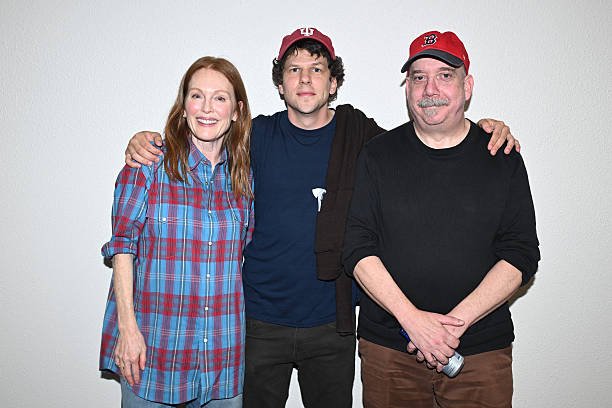
Jesse Eisenberg may have delivered his most ambitious directorial statement yet with The Debut, a darkly comic drama that premiered at the Telluride Film Festival and is already generating serious awards-season conversation.
The film, Eisenberg’s third feature as a director, revolves around an ordinary woman who becomes almost dangerously obsessed with a seemingly insignificant community-theater role. What begins as a story about amateur performers gradually transforms into something much more intense, exploring ambition, insecurity, artistic obsession and the desperate desire to be seen.
At the center of the movie are two celebrated performers: Julianne Moore and Paul Giamatti.
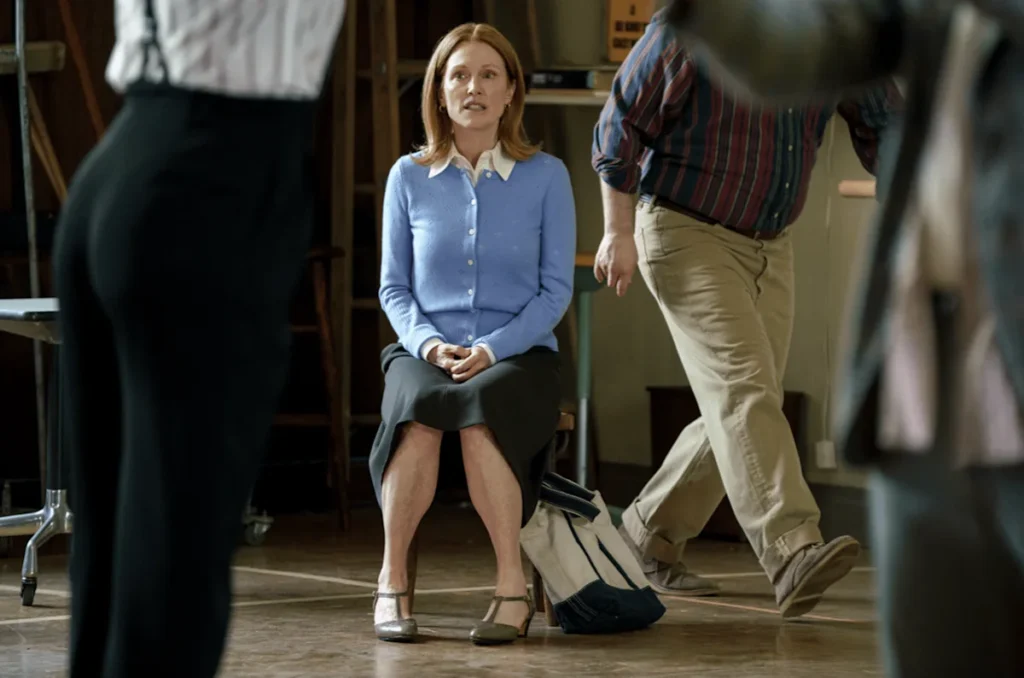
Moore plays Mona Friedman, a reserved housewife who hasn’t performed publicly since her days in a church choir. When she unexpectedly receives a role in a community-theater production, the experience awakens something inside her. What initially appears to be a modest opportunity becomes an all-consuming obsession.
Giamatti plays Jerry, the demanding and intimidating director of the production, a man who regards himself as the most important figure in New Jersey’s community-theater scene.
Together, Moore and Giamatti create the combustible center of a movie that reportedly moves between comedy, psychological intensity and unexpectedly emotional territory.
A Telluride Premiere That Could Change the Oscar Conversation
The Debut arrived at Telluride with considerable curiosity surrounding Eisenberg’s latest work.
The filmmaker and actor has increasingly established himself as a serious writer-director. His previous feature, A Real Pain, received significant acclaim and earned Kieran Culkin an Academy Award for his performance.
That success raised expectations for whatever Eisenberg would make next.
With The Debut, he appears to have created a completely different type of showcase.
Rather than focusing on a conventional dramatic storyline, Eisenberg takes the familiar world of community theater and pushes it toward psychological extremes.
The result has been described as a combination of theatrical satire, dark comedy and character-driven drama.
Rebecca Keegan of NBC News moderated the Telluride Q&A featuring Eisenberg, Moore and Giamatti. Notably, it was Giamatti’s first time watching the finished film, adding another layer of anticipation to the event.

Julianne Moore Delivers a Potential Awards-Worthy Performance
Julianne Moore may be the biggest reason The Debut is suddenly entering the awards conversation.
The actress has already established one of the most respected careers of her generation. She has received multiple Academy Award nominations and won for her performance in Still Alice.
Mona Friedman offers Moore another opportunity to demonstrate the extraordinary range that has defined her career.
At the beginning of the film, Mona is presented as quiet, hesitant and relatively invisible.
She is someone who appears to have spent much of her life occupying the background.
The community-theater opportunity changes that.
Instead of simply enjoying her chance to perform, Mona becomes increasingly invested in the role.
Her behavior grows more intense.
Her commitment becomes obsessive.
And what could have been a conventional story about a middle-aged woman discovering a new passion reportedly turns into something much darker and more unpredictable.
That gives Moore an enormous amount of material to play with.
She has to transition between vulnerability, comedy, determination and emotional volatility while maintaining the character’s underlying humanity.
Could This Be Moore’s Sixth Oscar Nomination?
The early response to Moore’s performance has immediately raised the possibility of another Academy Award nomination.
The role is the type of showcase that awards voters often respond to: a complicated character that allows a respected performer to completely transform herself.
Mona isn’t simply designed to be sympathetic.
She can be awkward, obsessive, funny and frightening.
That complexity could make the performance particularly memorable during an awards season filled with major contenders.
Moore’s previous Oscar recognition also gives her an advantage.
She is already a familiar name to Academy voters, while a performance this showy could remind audiences why she has remained one of cinema’s most respected performers.
Whether that ultimately results in another Oscar win remains impossible to predict, but the performance appears to have positioned her as an important contender.
Paul Giamatti Has His Own Oscar Story
While Moore may have the more obvious awards narrative, Paul Giamatti’s potential campaign could be equally compelling.
Giamatti is widely regarded as one of the most talented actors of his generation, yet he has never won an Academy Award.
That makes The Debut particularly interesting for awards watchers.
His performance as Jerry gives him a very different kind of showcase.
Jerry is the tyrannical director of the community-theater production, a man whose confidence and authority appear to far exceed the importance of the production itself.
He is demanding, theatrical and intimidating.
But Giamatti reportedly gives the character enough humanity to prevent him from becoming a simple caricature.
That balance is important.
The best supporting performances often involve characters who dominate the screen without necessarily being the protagonist.
Jerry appears to fit that description.
He is the kind of character who can enter a scene and immediately change its energy.
A Supporting Actor Race Could Be Giamatti’s Best Opportunity
Giamatti’s most realistic awards pathway could potentially come through the supporting-actor category.
His performance is reportedly more flamboyant and immediately quotable than Moore’s, giving him moments that could stand out during awards screenings and clips.
The character also plays into a familiar cinematic archetype: the demanding mentor or tyrannical creative authority.
However, The Debut appears to give Jerry more emotional complexity than the traditional version of that character.
That could prevent the role from feeling derivative.
For Giamatti, an Oscar win would also carry the weight of an overdue-career narrative.
He has previously been celebrated for performances in films such as Sideways and The Holdovers, among many others.
His acclaimed work has earned major recognition over the years, but the Academy’s top acting prize has remained out of reach.
If The Debut continues to gain momentum, Giamatti could finally have another strong opportunity.
The Film’s Connection to Acting Itself
One of the most fascinating aspects of The Debut is that the movie appears to be less interested in theater as a setting than in acting as an obsession.
The story takes place around an original stage musical, but the film isn’t necessarily structured like a traditional movie musical.
Instead, the production becomes a backdrop for examining why people perform.
Why do ordinary people want to stand in front of an audience?
Why does being seen matter so much?
And what happens when an actor becomes convinced that a small part is actually the most important role of their life?
Those questions appear to drive Mona’s journey.
The movie takes the familiar theatrical saying that “there are no small parts, only small actors” and turns it into something much more complicated.
A Darkly Comic Mix of Influences
The film has been compared in spirit to movies such as Black Swan, Whiplash and Waiting for Guffman.
Those comparisons suggest the movie occupies an unusual tonal space.
Like Black Swan, it explores artistic obsession and the psychological consequences of pursuing perfection.
Like Whiplash, it examines the relationship between an intense director and a performer willing to push beyond normal boundaries.
And like Waiting for Guffman, it finds comedy in the eccentric personalities and ambitions of community theater.
But The Debut appears to combine these influences into its own identity.
The result is reportedly funny at first, then increasingly ferocious before moving into unexpectedly emotional territory.
Jesse Eisenberg Continues His Directorial Evolution
Eisenberg’s work behind the camera is becoming increasingly interesting.
Although audiences initially know him primarily as an actor, his directing career has demonstrated a clear interest in complicated relationships and emotionally uncomfortable situations.
A Real Pain established his ability to combine humor and emotional depth.
The Debut appears to take that approach in a much more theatrical direction.
The project also allows Eisenberg to build a film around major performers rather than simply placing himself at the center of the story.
That is significant because one of the filmmaker’s apparent strengths is understanding how to create material that allows actors to showcase their abilities.
After helping Kieran Culkin win an Oscar for A Real Pain, Eisenberg now appears to have constructed another potential awards vehicle.
This time, however, the spotlight could fall on two veteran performers.
A Strong Supporting Cast Adds to the Appeal
Moore and Giamatti are not the only recognizable performers attached to the film.
The supporting cast includes Bernadette Peters and Halle Bailey, adding performers with significant musical and theatrical credentials to a movie centered on an amateur stage production.
Their presence helps reinforce the film’s connection to performance culture.
Rather than creating a generic comedy about a local theater group, Eisenberg appears to have assembled a cast capable of bringing authenticity and theatrical energy to the world of the movie.
That becomes particularly important when a film is dealing with actors playing actors.
The performances need to feel convincing without becoming overly artificial.
Strong Creative Talent Behind the Camera
The film also has an impressive creative team.
Cinematographer Drew Daniels, known for his work on Anora, brings his visual experience to the project.
The score comes from Emil Mosseri, whose work on Minari earned significant awards recognition.
Together, these filmmakers help give The Debut a creative identity beyond its unusual premise.
The combination of an unconventional story, major acting talent and experienced filmmakers could explain why the film has generated such strong attention following its festival premiere.
Why A24 Could Be Betting Big on The Debut
The Debut is scheduled for theatrical release on December 11, a date that places the film directly within the awards-season calendar.
That timing is significant.
Studios frequently use late-year releases to position prestigious films for consideration during awards season.
A December release can give The Debut an opportunity to build momentum through critics’ groups, industry screenings and audience word-of-mouth before major awards nominations are announced.
The film’s distributor also has extensive experience with unconventional movies that ultimately become major awards contenders.
A24 has previously released films that went from festival discoveries to Best Picture winners, including Moonlight and Everything Everywhere All at Once.
That history makes The Debut‘s awards positioning particularly interesting.
The Telluride Effect
The Telluride Film Festival has a long-standing reputation for showcasing movies that become important parts of the fall awards conversation.
A strong response at the festival can provide a movie with valuable early momentum.
For The Debut, the combination of positive attention, two highly respected lead performers and Eisenberg’s recent Oscar success creates a potentially powerful awards narrative.
The biggest question now is whether that festival enthusiasm can translate into sustained momentum once the broader awards season begins.

Could The Debut Become an Oscar Contender?
It’s still early in the awards race, and no festival premiere can guarantee an Academy Award nomination.
However, The Debut has several characteristics that could make it a serious contender.
Julianne Moore has a substantial awards history and a role that appears designed to showcase her range.
Paul Giamatti has the appeal of an acclaimed veteran actor still seeking his first Oscar win.
Jesse Eisenberg is coming off a major directing and writing success.
The film has a December release date.
And its distributor has a history of successfully turning unconventional films into awards-season favorites.
Those factors don’t guarantee anything, but they certainly make the movie one to watch.
The Debut Turns a Small Role Into a Big Movie
There is an appealing irony at the heart of The Debut.
The movie is about a woman who becomes convinced that a seemingly insignificant theater role deserves the commitment of a lifetime.
Yet the movie itself may turn out to be one of the most significant titles of the fall awards season.
That contrast appears to be exactly what Eisenberg is exploring.
Mona wants to be noticed.
She wants her performance to matter.
And eventually, she becomes willing to go much further than anyone around her expects.
The story therefore becomes about more than community theater.
It becomes a meditation on ambition and the human need for recognition.
For Moore, it could provide another career-defining performance.
For Giamatti, it could finally offer the kind of awards vehicle that turns years of admiration into an Academy Award.
And for Eisenberg, it could confirm that A Real Pain was not a one-off achievement, but evidence of a filmmaker with a distinctive voice.
With its Telluride debut behind it and its December theatrical release ahead, The Debut has already entered the awards conversation.
Whether it ultimately reaches the Oscar stage remains to be seen.
But if the early reaction is any indication, audiences may be hearing much more about Julianne Moore, Paul Giamatti and Jesse Eisenberg when awards season reaches its peak.
After all, as the old theater saying goes, there may be no small parts.
And The Debut appears determined to prove that even the smallest stage can produce a very big performance.