
When people think of late 1970s and early 1980s television, few shows stand out quite like Mork & Mindy. The sitcom not only made Robin Williams a household name but also cemented itself as a quirky piece of TV history. A spinoff from Happy Days, it blended science fiction and comedy in ways audiences had never seen before.
Yet, despite its cultural impact, the show was canceled after four seasons—right before a wild fifth season that would have involved time travel and historical adventures. Even more surprising is that some of these ideas were far enough along to have promotional photos taken, but no episodes were ever filmed.
So, what happened? Let’s dive into the strange and fascinating story behind Mork & Mindy’s unaired season and the twists that shaped its legacy.
The Rise of Mork & Mindy
Premiering in 1978, Mork & Mindy was born from an unusual idea. Mork, an alien from the planet Ork, had first appeared in an episode of Happy Days. The concept sounded absurd at first—an alien in 1950s Milwaukee meeting Richie Cunningham—but thanks to Robin Williams’ manic improvisation, the character was an instant hit.

Recognizing the potential, producers gave Mork his own spinoff series. In the show, he travels to Earth in the late 1970s and forms a friendship—and eventual romance—with a young woman named Mindy, played by Pam Dawber.
The early ratings were strong. Audiences loved Williams’ zany, unpredictable energy. For a while, it seemed like the show could run for years.
When the Ratings Dropped
Like many TV hits, Mork & Mindy struggled to maintain its momentum. After a dazzling start, ratings began to decline. Networks tried everything to keep audiences engaged.
Robin Williams later described this period with biting humor: “It became Hitler in the bunker, where they’ll try anything. Mork marries Mindy. Mork wants children. Mork is Mindy. Anything!” The show, he felt, was no longer the free-spirited comedy that first connected with audiences.
By the fourth season, it was clear that the magic was slipping away. ABC made the difficult decision to cancel the series. Williams learned about it the hard way: by reading Variety. As he joked years later, “That’s like reading your own obituary: ‘You’re dead, good luck!’”
The Last Episode That Did Air
Before the plug was pulled, the writers had planned a three-part storyline titled Gotta Run to end Season 4. However, when cancellation was confirmed, the team reshaped the finale into an episode called The Mork Report.

In this episode, Mork prepares a thesis for his alien superior, Orson, on the keys to a successful marriage. The lessons include honesty, respect, romance, and compatibility. Through flashbacks, the audience revisits moments from Mork and Mindy’s relationship.
- Honesty: Mindy admits she dislikes a dress Mork gave her.
- Respect: Mindy tolerates Mork’s alien rituals without mocking him.
- Romance: A sweet kitchen dance interrupts a meal prep.
- Compatibility: Even when they clash, they know how to compromise.
The finale wrapped with a surreal punchline: Orson rewards Mork by saying he has “earned his stripes,” at which point a zebra appears. It was a quirky, bittersweet farewell that felt very Mork & Mindy.
The Lost Season 5: Mork & Mindy Through Time
While audiences never saw it, there was already a plan in place for Season 5. According to executive producer Brian Levant, the idea was ambitious.

Here’s the setup: Mork befriends another alien, Kalnik, who later reveals himself as an enemy. When Kalnik threatens Mork, he and Mindy expose themselves to the public as an alien-human couple. To escape danger, they begin traveling through time, encountering famous historical figures along the way.
Levant even revealed that the season would have been “semi-educational,” blending humor with history. Promotional materials, including photos of Mork and Mindy alongside figures like Abraham Lincoln and Benjamin Franklin, were already created before the cancellation halted everything.
Why It Never Happened
No scripts were filmed, and the concept remained only on paper and in photo shoots. In some ways, it might have been ahead of its time. Mixing comedy with time travel and history lessons feels like something that would resonate in today’s era of genre mashups.
At the time, though, the ratings were already slipping. Networks were hesitant to gamble on an expensive, high-concept rebrand for a show that had lost its core audience.
So, the time-traveling adventures of Mork and Mindy never made it to screen.
The Unlikely Origins of Mork
The very existence of Mork & Mindy can be credited to Garry Marshall’s son, Scott. As Marshall explained in a later interview, his 7-year-old stopped watching Happy Days because there weren’t enough space elements. “I like aliens. I like space,” Scott told his dad.
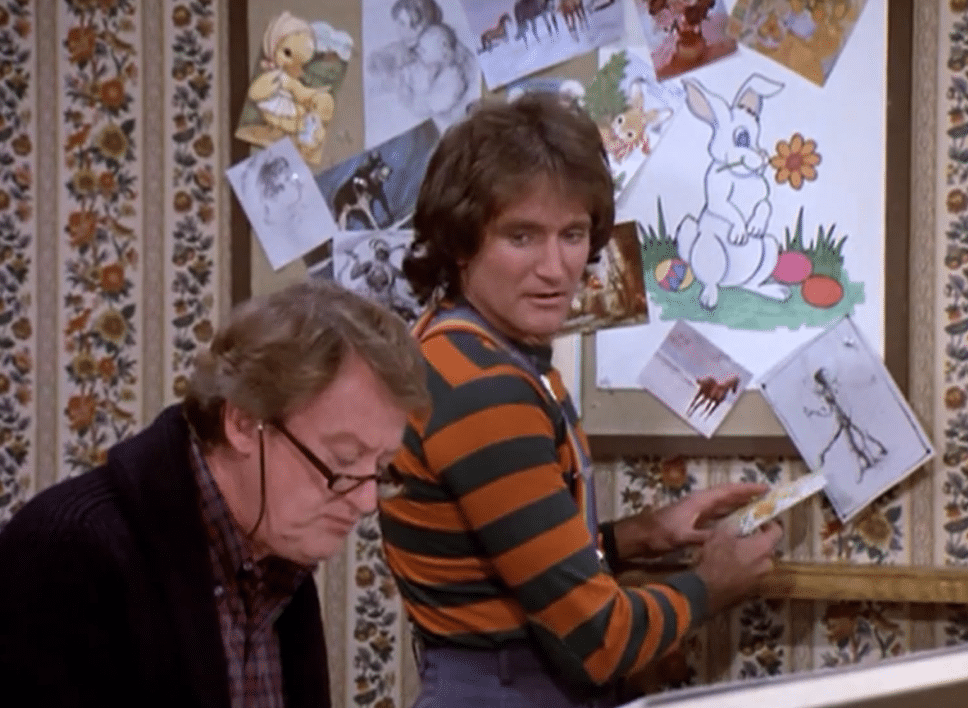
Taking his son’s advice seriously, Marshall brought the idea into the writers’ room. “Let’s put a spaceman on Happy Days!” he announced. Though the writers initially thought it was a terrible idea, they went along with it. That decision, born from a child’s casual comment, gave Robin Williams his big break.
Robin Williams: The Star Who Outshone the Show
Even as the show stumbled in later seasons, Robin Williams’ performance remained unforgettable. His improvisational genius, quick wit, and boundless energy turned Mork into one of TV’s most beloved characters.
Williams would go on to enjoy a remarkable career in film, from Good Morning, Vietnam to Mrs. Doubtfire and Good Will Hunting. Yet, for many fans, his first great showcase was as the quirky alien in rainbow suspenders.
The Legacy of Mork & Mindy
Though it only lasted four seasons, Mork & Mindy left behind a fascinating legacy:
- It launched Robin Williams into stardom.
- It proved that even bizarre TV experiments can become cultural milestones.
- Its “lost season” remains one of the strangest “what ifs” in television history.
The series finale may not have been the time-traveling adventure producers envisioned, but it did what mattered most: it ended with Mork and Mindy together, their love story intact, quirky zebra and all.
Conclusion
Mork & Mindy might not have lived long enough to realize its strangest ambitions, but its story continues to fascinate fans decades later. From its origins in a child’s imagination to the unaired time-travel season, the sitcom remains one of TV’s quirkiest gems.
And while audiences never saw Mork and Mindy meet Abraham Lincoln or Benjamin Franklin, the idea itself captures the playful spirit of the show. Much like Robin Williams himself, Mork & Mindy was unpredictable, full of heart, and endlessly original.