
When a world-renowned actor takes on the role of one of the most polarizing figures in modern history, it is bound to generate curiosity. That’s exactly what happened when Jude Law stepped into the shoes of Vladimir Putin for Olivier Assayas’ new political thriller The Wizard of the Kremlin, which had its grand premiere at the Venice Film Festival.
The film, adapted from Giuliano da Empoli’s bestselling novel, explores the rise of Putin during the turbulent post-Soviet era and his close association with Vadim Baranov, a fictional character inspired by real-life political strategist Vladislav Surkov. With a star-studded cast that includes Paul Dano, Alicia Vikander, Tom Sturridge, and Jeffrey Wright, the film dives deep into the origins of modern political manipulation and authoritarian control.
But perhaps the biggest question hovering around the film is: how does one portray Putin on screen without creating unnecessary controversy? Jude Law’s answer is simple yet striking — by focusing on nuance, humanity, and storytelling rather than sensationalism.
Jude Law’s Confidence in the Role
At the official press conference in Venice, Jude Law made it clear that he wasn’t concerned about potential backlash for playing Putin.
“I hope not naively, but I didn’t fear repercussions,” he explained. “I felt confident, in the hands of Olivier and the script, that this story was going to be told intelligently and with nuance and consideration. We weren’t looking for controversy for controversy’s sake. It’s a character in a broader story. We weren’t trying to define anything about anyone.”
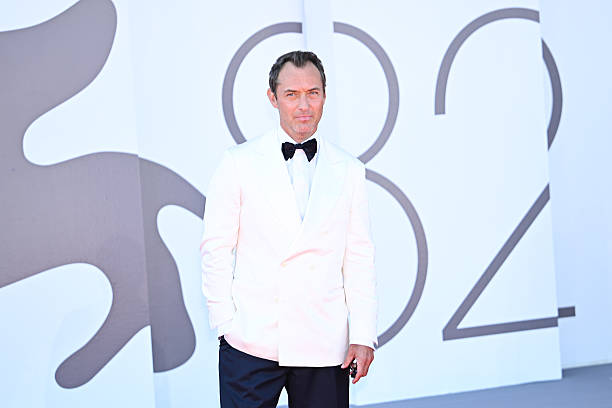
Law emphasized that this film wasn’t about caricature or political judgment. Instead, it was about exploring a figure within a much larger narrative of power and influence.
Physical Transformation Without Mimicry
To embody a younger version of Putin, Jude Law worked with a skilled hair and makeup team. But he deliberately chose not to imitate the Russian leader’s accent or hide behind heavy prosthetics.
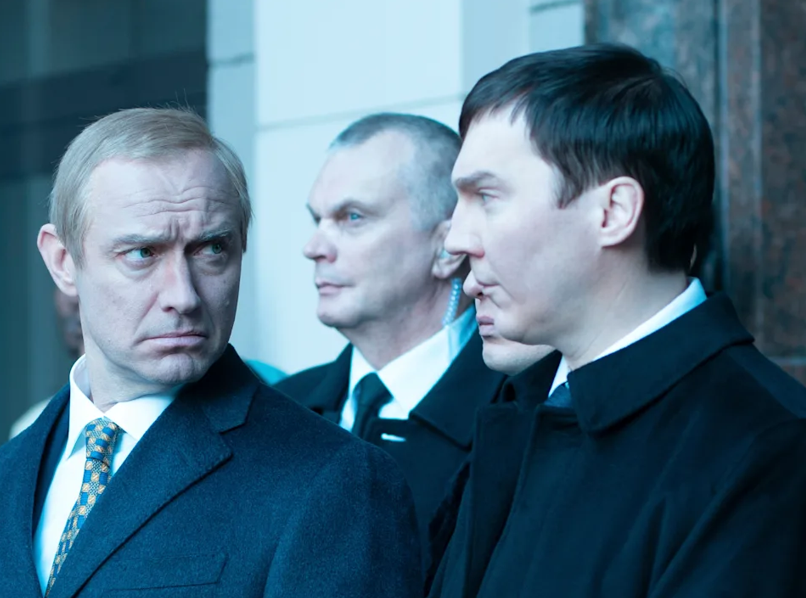
“Olivier and I discussed that this wasn’t to be an impersonation,” Law revealed. “He didn’t want me to hide behind a mask. We worked with incredible makeup and hair experts, using references from that period in Putin’s life. We tried to find familiarity within myself rather than mimicry. It’s amazing what a great wig can do.”
This choice kept Law’s portrayal grounded and accessible, focusing less on external imitation and more on internal character study.
Paul Dano on Playing Vadim Baranov
Alongside Law, Paul Dano plays Vadim Baranov, a fictional “fixer” inspired by Putin’s real-life spin doctor, Vladislav Surkov. Dano explained that his goal was not to present a simplistic “villain” but to explore the psychology behind such a character.
“I don’t think you need to look for a positive, but you need to be willing to discover the point of view of the character,” Dano said. “If you were to just label Baranov as bad, it would be a massive oversimplification. We need to be asking ‘Why?’”
By focusing on the why instead of the what, Dano approached his character with complexity, giving the audience a layered perspective into the machinery of political propaganda.
The Director’s Vision – A Cautionary Tale
Olivier Assayas, the acclaimed French filmmaker behind the project, was asked at Venice whether he believes Russia “rules the world.” His answer was concise: “That’s an easy one. The answer is no.”
But Assayas stressed that the film is not merely a biopic or a political retelling. Instead, it is meant to serve as a cautionary tale about the transformation of politics in the modern era.
“The film is very much about how modern politics were invented,” he said. “Part of that darkness arose from the rise of power of Vladimir Putin in Russia. We made a movie about what politics has become and the dangerous situation that we all feel we’re in. It applies to many authoritarian leaders, not just one.”
Global Resonance of the Story
The themes of The Wizard of the Kremlin feel especially relevant today, given Russia’s ongoing war in Ukraine. The film reflects not just on Russia’s past but also on the global implications of authoritarian rule.
Actor Jeffrey Wright, who plays a key role in the film, highlighted this during the press conference. “This film is about a specific place, but it has global implications for all of us,” Wright explained. “Yes, Russia has its history, and America has its own history, too. We’ve had impulses toward fascism, autocracy, and all manner of sins. But what has always been present — at least as an aspiration — is the belief that we can be better. If that idea is lost, we become the very thing we fear.”
His words underline why the film is not just a political drama but also a mirror reflecting global society’s struggles with democracy, power, and hope.
Why the Film Matters Today
The Wizard of the Kremlin arrives at a time when politics worldwide is in flux. Leaders across the globe are often accused of adopting authoritarian styles, manipulating media narratives, and consolidating power in ways that echo the themes of this film.
The Venice Film Festival has always been a stage for bold, thought-provoking cinema, and this movie fits right in. By telling a story rooted in Russia’s transformation, yet reflecting universally, Assayas and his cast have created a film that challenges audiences to reflect on the present.
Final Thoughts
Jude Law’s portrayal of Vladimir Putin in The Wizard of the Kremlin is not about imitation, but about interpretation. By steering away from controversy-driven choices, the actor and director have crafted a nuanced exploration of power, propaganda, and politics.
The film may be set in Russia, but its echoes are global. It forces us to question how politics has evolved, where it might be headed, and whether societies are prepared to resist the temptations of authoritarian control.
As Law himself emphasized, this isn’t a story about glorification or condemnation — it’s a story about the structures of power, told with depth, intelligence, and artistry. And in today’s political climate, that’s exactly the kind of storytelling that matters.