
After more than two decades in film and television, Rebecca Ferguson continues to redefine what it means to be a versatile performer. Known for embodying extraordinary characters in fantastical settings — from The Greatest Showman to Doctor Sleep, and from the Mission: Impossible to Dune franchises — Ferguson has built a career that balances strength, mystery, and depth. Yet, in her latest role in A House of Dynamite, she takes on something completely different: a woman whose greatest challenges are rooted not in action or adventure, but in human vulnerability.
A New Challenge: Playing “Just a Normal Human Being”
Ferguson stars as Olivia Walker, a working mother who leads the Situation Room in the White House — the nerve center responsible for coordinating the U.S. response to nuclear threats. Despite the high-stakes setting, Olivia isn’t a superhero or a secret agent. She’s a professional trying to keep her composure in a world that could collapse at any second.

“The roles that I had done thus far, they’ve all been characters,” Ferguson said. “And what I haven’t done is to just be a normal human being.” That’s exactly what drew her to this project — and to director Kathryn Bigelow.
The Kathryn Bigelow Connection
When Bigelow approached Ferguson about the role, the actor didn’t hesitate. “The fact that Kathryn Bigelow wanted me to play a role in a film, that was enough for me,” she said.

Bigelow, who made history as the first woman to win an Oscar for Best Director with The Hurt Locker, returns to familiar territory with A House of Dynamite. The film, written by Noah Oppenheim (Jackie), is a tense political thriller about the race to identify and respond after an untraceable missile is launched toward the United States.
The ensemble cast includes heavyweights like Idris Elba, Jared Harris, Gabriel Basso, Greta Lee, Jason Clarke, Tracy Letts, and Anthony Ramos — a lineup that promises explosive chemistry and emotional authenticity.
Research, Realism, and Trust
For Ferguson, accuracy was essential. She wanted Olivia Walker’s behavior and reactions to feel real, not theatrical. “I wanted to do research. I wanted it to be correct,” she explained.
To achieve that, Bigelow enlisted Larry Pfeiffer, a 32-year veteran of the intelligence community and former senior director of the real Situation Room, as a consultant. “Larry was on set every day,” Ferguson said. “He was basically the guy Jason Clarke plays in the film.”
From Pfeiffer, she learned that maintaining composure under pressure is rule number one. “He told me, ‘You never lose your composure in the Situation Room. If you need a break, you leave — but you never lose control.’” Ferguson took that advice to heart — even using it during one intense filming moment where she instinctively walked out of the room to collect herself. Bigelow noticed.
“Kathryn said, ‘Why did you walk in there?’ I told her I felt that was a moment where my character would’ve felt too much,” Ferguson recalled. “She said, ‘That’s great. Let’s put a camera in there and do that again.’”
A Director Who Listens
Bigelow is known for combining military precision with emotional depth in her storytelling. Ferguson praised her director’s ability to sense authenticity in every gesture and decision. “She follows you. But she’s still in control. She’s the director,” Ferguson said. “It’s like she conducts an orchestra — she knows when the violins aren’t tuned or when the cello isn’t loud enough. She’ll adjust either the camera or the moment itself.”
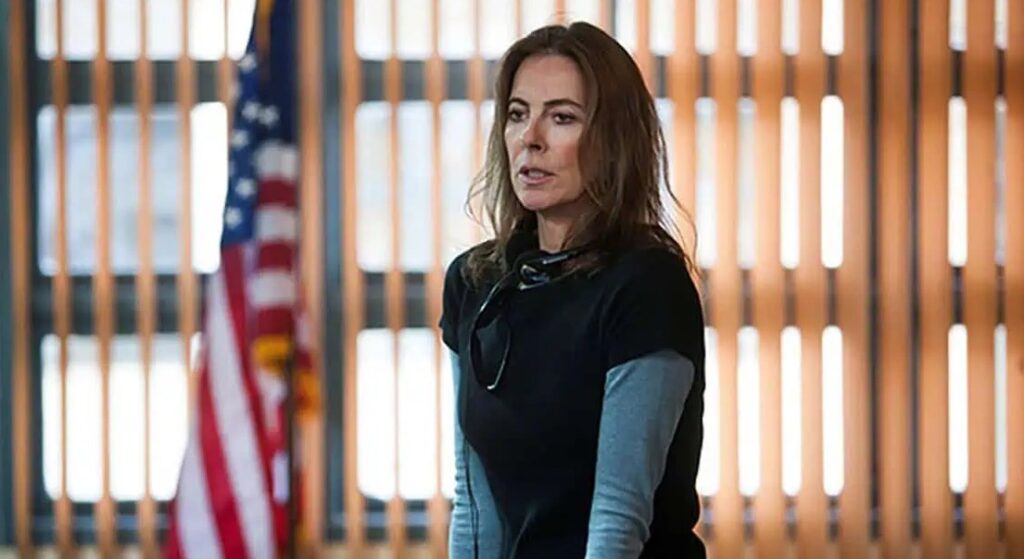
For Ferguson, working with Bigelow was “a dance between soldiers, actors, and cameras,” where the energy on set was electric but grounded in truth.
The Bond Between Cast and Crew
Despite the film’s tension-filled subject, Ferguson said the set environment was warm, inclusive, and collaborative. The cast — including Elba, Ramos, Lee, and Clarke — often ate together, fostering genuine camaraderie. “I didn’t see any of the actors go back to their trailer to eat lunch alone. Everyone was together. It was team-building,” she shared.

She grew particularly close to co-stars Malachi Beasley and Brett Tomberlin, even forming a small group nicknamed “The Three Bears.” “I did a rap for them about Goldilocks and the Three Bears, and it made them laugh,” she said with a smile.
Bringing Real Emotion to the Role
While Olivia Walker operates under unimaginable pressure at work, Ferguson found her emotional anchor in motherhood — both on and off-screen. She recalled one particularly touching scene where Olivia tucks her young son, played by Nicholas E. Monterosso, into bed.

“That little moment — that was me with my own daughter or my son when he was little,” she said. During rehearsal, Ferguson suggested a small improvisation. “I asked my co-star to give me a dinosaur toy. Kathryn loved it. She always says, ‘I love that,’ when something feels real.”
That toy later became a recurring symbol in the film. “We decided to leave the toy in Olivia’s shoe when she changes into heels at the White House,” Ferguson explained. “It became this little trail of her son throughout the story — something that I would’ve done myself.”
The Art of Collaboration
Bigelow and Ferguson’s collaboration was built on trust, intuition, and emotional honesty. Ferguson described the process as deeply fulfilling: “Everything Kathryn does is impactful. The whole experience of being in her environment — that’s the thrill.”

Even months after filming wrapped, Ferguson found herself reflecting on the themes of the movie. “When an existential threat is upon us, it’s about the domino effect of decision-making and what the repercussions are for humanity,” she said thoughtfully. “But it’s more than that, too. It’s one of my favorite films I’ve ever been part of.”
A House of Truth and Humanity
While A House of Dynamite deals with nuclear threats and global crises, at its heart it’s a story about human connection and composure under pressure. For Rebecca Ferguson, it was an opportunity to step away from fantasy and action — and instead embrace the complexity of being “just human.”
As Olivia Walker, she embodies the quiet heroism that exists in empathy, reason, and resolve. And through Kathryn Bigelow’s steady direction, she reminds audiences that even in the face of catastrophe, authenticity and truth still matter most.